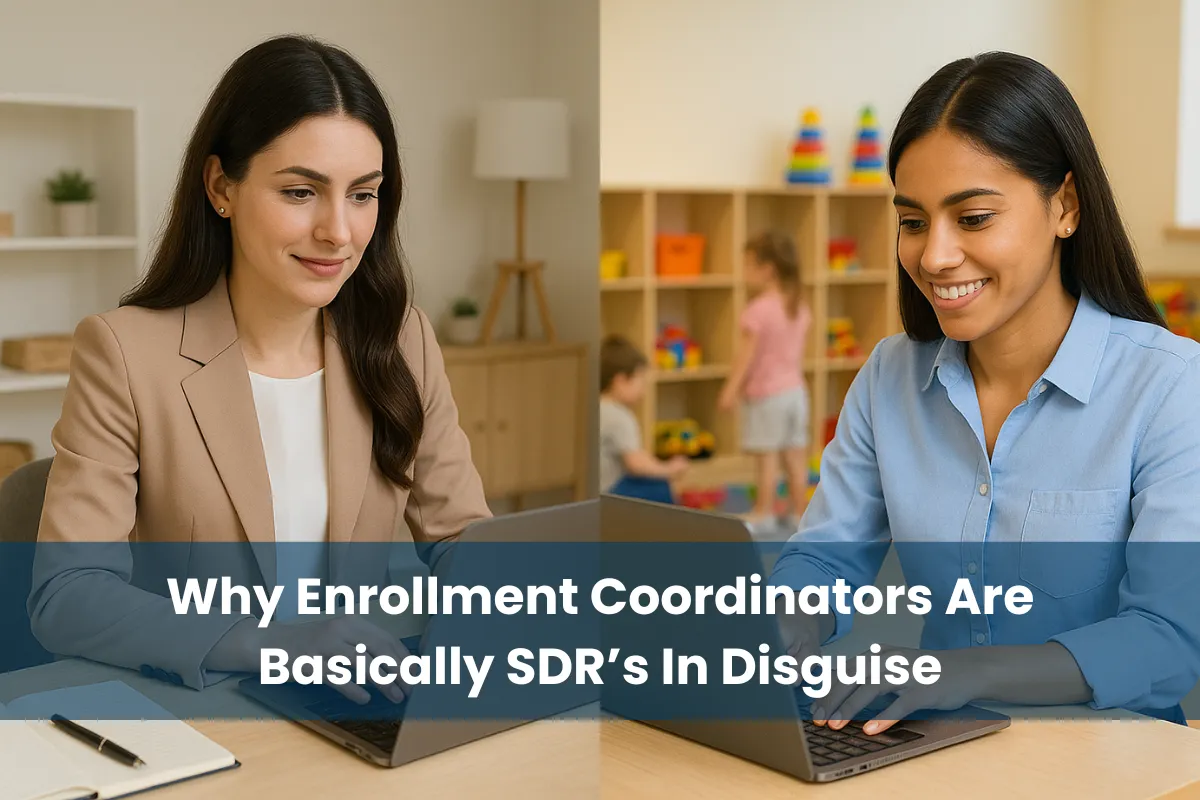
Why Enrollment Coordinators Are Basically SDRs in Disguise
Why Enrollment Coordinators Are Basically SDRs in Disguise
—From a Former Cold Caller Turned ECE Insider
Before I worked in early childhood education, I was an SDR — a sales development rep in the tech world. My days were a blur of cold calls, quick pitches, and trying to convince total strangers to book 15 minutes with me. Glamorous? Not quite. But valuable? More than I ever realized.
Now, working alongside enrollment teams in ECE, I see it clearly: enrollment coordinators are the SDRs of the childcare world.
Here’s how the overlap plays out — and why it matters.
1. You’re the First Impression
In tech sales, SDRs aren’t closing deals. They’re opening doors. They're the first human touchpoint a lead ever has. If that first touch feels off — rushed, robotic, or unsure — the rest of the sales process suffers.
Enrollment coordinators are exactly the same. You’re the first voice, the first email, the first smile. Families don’t care who the director is if their first point of contact didn’t feel like someone who gets them.
First impressions aren’t just important. They’re everything.
2. You Know How to Build Trust Fast
Cold calling teaches you how to build rapport in under 30 seconds. Not with scripts — with tone, listening, empathy, and energy. You have to meet someone where they are, fast.
Families calling or touring your center are often anxious, busy, and overwhelmed. Your job? Make them feel seen. Calm the chaos. Whether it’s their first child or their third, every parent wants to feel like they’re making the right choice — and you're the one who sets that tone.
3. Follow-Up Is Your Secret Weapon
An SDR who gives up after one call? Useless. A great SDR follows up without being annoying. They provide value, not pressure. They check in with something helpful or personal — not just “Hey, circling back…”
Enrollment works the same way. One tour isn’t always enough. Life gets in the way. But consistent, thoughtful follow-up — a quick note about how their child lit up in the toddler room, or a link to a parenting resource you think they’d like — builds trust.
It shows you're not just trying to fill a spot — you’re trying to support a family.
4. You’re Managing a Pipeline, Not Just a List
SDRs live by the pipeline. They track leads, stages, responses, touchpoints — because they know every contact matters. Nothing is random.
If your enrollment process is scattered, leads will fall through the cracks. The fix isn’t always more outreach. It’s better organization. Track where each family is, what they’ve seen, what they care about. You don’t need fancy tech — you need a system that works.
5. You Know It’s a Numbers Game — But a Human One
In SDR work, you might make 80 dials to book 8 calls — and maybe 2 of those convert. You learn not to take it personally. You also learn to make every single call count, because you never know who’s on the other end.
Enrollment is no different. Not every tour turns into a registration. That’s okay. What matters is showing up fully for the next one. Because that family might be the one that changes everything — for your center, and for their child.
The Bottom Line
If you’ve ever worked an SDR role, you know it builds grit. It sharpens your communication skills. It teaches you how to connect quickly, follow up smartly, and make people feel comfortable in uncertain moments.
Sound familiar?
Enrollment isn’t just about paperwork or answering phones. It’s about outreach, connection, and trust — the same muscles SDRs use every single day.
And if you’re doing it well? You’re not just an enrollment coordinator. You’re the heartbeat of your center’s growth.

